Salsa vs Bachata vs Kizomba: What Should Barcelona Beginners Learn First?
If you're new to Latin dance and only have one night in Barcelona, which style do you pick? A clear, music-led comparison of salsa, bachata, and kizomba — how each dance feels, what music to listen for, which Barcelona venues play what, and which to start with.
Barcelona has one of the strongest Latin-dance scenes in Europe, and three dances dominate it: salsa, bachata, and kizomba. They share venues, often share nights, and sometimes share teachers — which makes it confusing for beginners trying to decide which one to start with. This guide breaks down what each dance actually feels like, what music sounds like on the dance floor, where each is danced in Barcelona, and why most visitors are better off starting with salsa — at least for their first night out.
The 30-second answer
If you have one evening in Barcelona and have never danced any of the three: start with salsa. It is the most widely played at Barcelona Latin clubs, the easiest basic step to remember after one lesson, and the dance that gets the most floor time on a typical Friday or Saturday. The rooftop salsa class is built for exactly this — one hour of beginner instruction, then unstructured time to practice with sangria.
Bachata is the natural next step. Kizomba is the deepest of the three and rewards a course-length commitment more than a single drop-in lesson.
Salsa — the entry point
Music: Cuban and Puerto Rican origins; brass-heavy, fast (around 180–220 BPM); the rhythm is “quick-quick-slow, quick-quick-slow” over four beats.
Basic step: Forward-back-back-pause / back-forward-forward-pause. Eight counts total, six steps. You stay in roughly the same place on the floor — salsa is danced on the spot, not travelling.
Feel: Bright, percussive, social. You face your partner and rotate around each other. Hands stay up and connected. There is a lot of spinning for the follow once you get past the first lesson.
Styles you’ll see in Barcelona:
| Style | Origin | What’s distinctive |
|---|---|---|
| Cuban (Casino) | Cuba | Circular, partner rotates around shared centre; the “rueda de casino” is groups of couples doing called moves in a circle |
| LA-on-1 | Los Angeles | Linear, “slot” dance, breaks on count 1; flashier with dips and tricks |
| NY-on-2 | New York | Linear, breaks on count 2; more subtle, jazz-influenced |
The Barcelona rooftop class teaches Cuban-style social fundamentals — the linear basic plus partner rotation that works everywhere. You will not be drilled on a specific competitive style; the goal is moves you could actually use that night.
Where it’s danced in Barcelona: Salsa is the default at the city’s Latin clubs. It dominates the early part of any Latin night and most of the dedicated salsa venues. If you only learn one dance, this is the one you will get the most floor time on.
Bachata — the romantic counterpoint
Music: Dominican Republic origin; characterised by the bachata guitar (a lyrical, slightly bent-note electric guitar sound) plus bongos and güira. Slower than salsa — typically 120–140 BPM. Lyrics are romantic, often heartbroken.
Basic step: Side-side-tap, side-side-tap (with a slight hip pop on the tap). Four counts per side. You can dance it almost anywhere because the footprint is small.
Feel: Slower, closer, more intimate frame than salsa. Modern “sensual” bachata stretches the movements out and adds body waves; “traditional” Dominican bachata stays tighter and quicker. The sensual style is what dominates European clubs now and what most Barcelona bachata events teach.
Why it’s a natural second dance:
- The basic step is even easier to remember than salsa’s.
- Slower music means you have more time to think while learning.
- It pairs with salsa on the floor — most Barcelona Latin nights program both, often alternating sets.
Where it’s danced in Barcelona: Most salsa clubs program bachata sets too — usually the middle of the night. Dedicated bachata nights exist at multiple venues. The long-running Sala Apolo Bachata Wednesday has been discontinued — the bachata mid-week crowd has migrated to Sala Vivaldi (Miércoles Tardeo y Noche Bachatera) and the Dio Club / Seven Dance circuit. Antilla BCN Latin Club (now at Carrer d’Alcolea in Sants, after relocating from Carrer d’Aragó in late 2023) and Mojito Club (Carrer del Rosselló 217 in Eixample) both program weekly bachata sets.
A booking note from our FAQ: this site’s featured class teaches salsa, not bachata. If you specifically want bachata instruction, search “Barcelona bachata classes” — multiple dance schools in the city offer drop-in bachata sessions; the rooftop format with sangria is salsa-focused.
Kizomba — the deepest, hardest, slowest
Music: Angolan origin; rooted in Angolan semba and influenced by Cape Verdean and French Antillean styles. Slow (around 90–110 BPM), bass-heavy, smooth — almost trip-hop adjacent in feel. Modern kizomba clubs sometimes play “ghetto zouk” or “urban kiz” which sit alongside but are not the same dance.
Basic step: Walked rather than stepped — three steps forward, three steps back, with a hip-led weight transfer that takes time to feel. The connection is chest-to-chest, very close, with most of the communication coming through the lead’s chest movement.
Feel: Deeply connected, slow, almost meditative. Less “performance” than salsa or bachata — the entire dance is two people sharing one weight transfer at a time. It is also the hardest of the three to fake; without a proper lead-and-follow connection, kizomba breaks down.
Why beginners struggle with one-off lessons:
- The lead-and-follow connection requires real frame and weight, which takes more than one hour to install.
- It is danced very close; if you are uncomfortable with that proximity it will not feel right even with a willing partner.
- The music is sparser; without practice, the beat is harder to find than salsa’s brass-led count.
Where it’s danced in Barcelona: Kizomba has a smaller but devoted scene — dedicated kizomba nights and weekend socials exist, often programmed by specific kizomba schools rather than the general Latin clubs. If kizomba is your priority, look for a multi-week course rather than a drop-in — and search venues separately from the salsa-and-bachata mainstream.
Side-by-side: which to learn first
| Salsa | Bachata | Kizomba | |
|---|---|---|---|
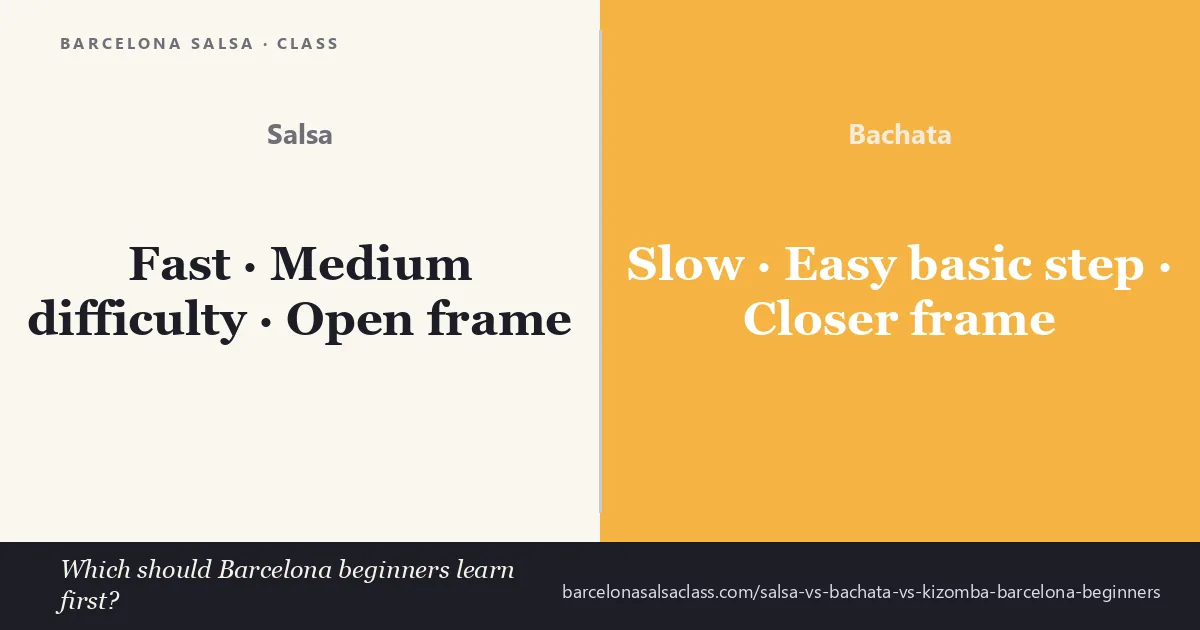
| Tempo | Fast (180–220 BPM) | Medium (120–140 BPM) | Slow (90–110 BPM) |
| Basic step difficulty | Medium (quick-quick-slow) | Easy (side-side-tap) | Hard (walked, hip-led) |
| Frame | Open, hand-hold | Closer, hand-hold to close | Very close, chest-to-chest |
| Music origin | Cuba / Puerto Rico | Dominican Republic | Angola |
| Floor share in Barcelona Latin clubs | Highest | Second | Smaller, dedicated nights |
| Best learning format for visitors | Drop-in class works | Drop-in class works | Multi-week course preferred |
| Pair with rooftop sangria? | Yes — featured format | Possible at other classes | Tone mismatch (too slow) |
For a one-night Barcelona visit, salsa is the obvious pick. For a long-weekend visitor with two evenings, do salsa first and bachata second — they reinforce each other on the dance floor. For a week-plus stay or repeat visitor, sign up for a kizomba intro at a dedicated school rather than improvising at a club.
Where each dance lives in Barcelona’s nightlife
The Latin scene clusters around El Born, El Raval, and Eixample, with beach-side venues on the Barceloneta side. Salsa and bachata are programmed at most venues; kizomba clusters at dedicated nights. Specific clubs and their current Latin programming change often — confirm the current week’s schedule on a venue’s social media before turning up. For a curated list and how to pick the right club for your hotel, see our where to dance salsa after class guide.
The 2026 Barcelona-area Latin festival calendar
For visitors whose trip overlaps a major Latin-dance congress, a festival changes the whole picture — you go from “one rooftop class + one Latin night” to four straight nights of social-dancing surrounded by 500–1,000 dancers. The 2026 calendar around Barcelona has four headline events worth knowing about:
| Festival | 2026 dates | Where | Style |
|---|---|---|---|
| Esencia Paradise International Bachata Congress | April 30 – May 3 | Barcelona city | Bachata (sensual + traditional) |
| BCN Dance Life HOT Weekend | July 24–27 | Santa Susanna (Barcelona coast) | Bachata + salsa |
| BCN Dance Life Bachata Congress | October 2–5 | Hotel Don Angel, Santa Susanna | Bachata (the city’s biggest) |
| Bachata Sensual World Congress (BSWC) | January 14–19 | Punta Umbría, Huelva | Bachata sensual (the global headline; note: NOT in Barcelona despite the naming) |
A festival weekend is an entirely different commitment from a rooftop class — multi-day pass, workshop schedule from morning, socials until 4 or 5am, several hundred dancers from across Europe and beyond. They are also where a beginner can watch the best dancers in the world up close, which is often the moment a casual interest tips into a sustained one. If a trip naturally overlaps one, the festival becomes the headline; the rooftop class is the warm-up the day you arrive.
How the rooftop class fits the bigger picture
The Barcelona rooftop salsa class is built as a first lesson, not a course. Two hours, $58, beginner-friendly, instruction in English and Spanish, bottomless sangria on a Passeig de Gràcia rooftop. After it, the basic step lives in your muscle memory for a few weeks — enough to walk into a salsa night somewhere in the city and dance the early sets.
If you want to keep going beyond that lesson, Barcelona dance academies such as Seven Dance, U!Dance, and Dance Motion offer drop-in classes at multiple levels — beginner, improver, intermediate, advanced — typically around €15–€20 for a single 60–90 minute group lesson, with discounted class packs (bonos) for longer stays. Walking into one of these is much easier once the rooftop class has installed the basic step.
A common pattern at Seven Dance and similar academies is to run drop-in workshops in the hour before a social-dance night kicks off at the attached venue — Seven Dance is connected to Dio Club, for example, so you can take an hour-long bachata lesson and walk straight into the social at 23:00 without leaving the building. For visitors with a few days in Barcelona, this is the fastest path from “I can do the basic step” to “I can hold my own on a real social floor.” The full course commitment for installing solid fundamentals is typically 4–12 weekly sessions; the drop-in route is what works when you’ve only got 3 to 5 days in the city.
Ready to book?
The rooftop salsa class with bottomless sangria is rated 4.7/5 by 297 guests and is the city’s most-balanced first lesson for visitors. From $58 per person, two hours, English-Spanish instruction, bottomless red or white sangria, and a Passeig de Gràcia rooftop for sunset. Free cancellation up to 24 hours before.
Learn Salsa in Barcelona — Rooftop, Sangria, Sunset
Join 297+ guests who rated this rooftop salsa class 4.7/5. Two hours of beginner-friendly salsa instruction in English and Spanish, bottomless sangria, and panoramic Barcelona skyline views — all included. Free cancellation.
Check Availability & Book